“There is too little beauty in the world — it must be multiplied.”
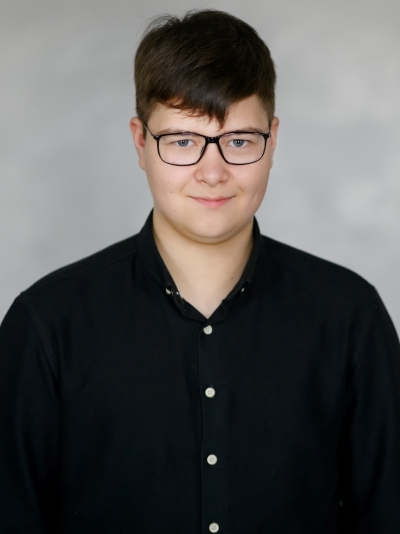
Dmitry Fedenko was born in 2007 in the city of Severodvinsk in the Arkhangelsk Region. From 2013 to 2019, he studied at the Borodin Children’s School of Arts in Saint Petersburg (class of Raisa Sverdlova). He subsequently graduated from the Secondary Special Music School of the Rimsky-Korsakov Saint Petersburg Conservatory in the class of Professor Alexander Sandler, Honoured Artist of Russia. He is currently a student of the Saint Petersburg Conservatory, continuing his studies with the same teacher. In 2019, he became the winner and recipient of a special prize at the 3rd International Competition for Young Pianists named after Nathan Perelman (Saint Petersburg), and was awarded Second Prize at the 8th International Competition named after Georgy Sviridov (Saint Petersburg). In 2020, he became a Third Prize laureate at the 12th International Competition for Young Pianists named after Sergei Rachmaninoff (Veliky Novgorod). In 2023, he was awarded First Prize at the 12th International Piano Competition named after Maria Yudina (Saint Petersburg); Second Prize at the 4th International Competition for Young Pianists Robert Schumann Competition (Düsseldorf); and the Grand Prix at the 5th All-Russian Competition for Young Musicians Constellation (Sochi, Sirius). He maintains an active concert career and collaborates with leading symphony orchestras.
Saint Petersburg Music House (SPMH): You have recently returned from Crimea, where the Saint Petersburg Music House held its April Intensive. What impressions did these master classes leave on you?Dmitry Fedenko: This was my first time taking part in this Music House project. I immediately felt the wonderful atmosphere that prevailed there: friendly relationships with colleagues, true mentorship from the masters, which was incredibly valuable, and inspiration drawn from the concerts. Everything was organized in such a way that the participants could work as productively as possible, discover new things, and reflect deeply.
SPMH: In your opinion, what is the advantage of such a format of study, and how does it complement your regular classes at the conservatory?
Dmitry Fedenko: It seems to me that an “intensive” is a form of total immersion, when you are pulled out of your ordinary life, usually filled with countless events and everyday concerns, and are able to focus seriously and without distraction solely on what is truly important at that particular moment in time. In everyday life this is not always possible, which is why this format feels especially complete and effective for moving forward.
SPMH: As part of this project, concerts were also held. Among other works, you performed Liszt’s étude Mazeppa. This composition is not only extraordinarily demanding technically, but also highly complex in terms of its idea and artistic concept—it is no coincidence that Liszt united these études into a cycle entitled Transcendental, works that go beyond the limits of ordinary understanding. How did you approach the challenge set by the composer?
Dmitry Fedenko: I first performed this work during a creative session at the Sirius Educational Center in July 2023. Naturally, my interpretation of Mazeppa has gradually evolved together with me. Very often, the opinions and advice of people who are more experienced and wiser than I am opened entirely new meanings to me. The same happened during master classes with the teacher Vladimir Pavlovich Ovchinnikov, when we worked on this étude together, and for that I am deeply grateful to him.
SPMH: What should a musician strive for in order to captivate the audience as fully as possible through performance?
Dmitry Fedenko: In our world, everything changes so quickly that the human mind is no longer capable of fully absorbing all the information it receives, and therefore it tries to simplify it. Very often, in this process of simplification, everything becomes formalized. In my opinion, the musician’s main task is to interrupt the listener’s endless rush through life and immerse both soul and consciousness into the mystery and inner intention of the work, to try to ensure that a person does not leave the concert hall with an empty heart. There is too little beauty in the world—it must be multiplied.
SPMH: What role do the Music House projects play in your concert life?
Dmitry Fedenko: The projects of the Music House occupy a very important place in my life. I am deeply grateful for the trust placed in me to perform in the finest concert halls, together with leading conductors and orchestras, alongside talented colleagues. It is a unique opportunity to find and connect with one’s own audience.
SPMH: Did your interest in music arise naturally on its own, or did someone guide you onto this path?
Dmitry Fedenko: There have never been any professional musicians in my family, although my parents have always loved music. Once, when I was still very small, they took me to a classical music concert. I was so captivated by the sound of the clarinet that I literally crawled toward the instrument. My parents began to notice how strongly I was drawn to music. And when I grew a little older, I asked them to enroll me in music school—I had just turned four at the time.
SPMH: Why the piano?
Dmitry Fedenko: At first, it was not really a conscious choice. As it happened, not all instruments were available at that music school, and the main enrollment was directed toward the piano department. I very much wanted to continue studying music, so the choice fell on the piano. The beginning of this journey was not easy at all, but over time I realized that this truly is my instrument.
SPMH: In which musical style do you feel most naturally at home as a performer?
Dmitry Fedenko: Above all, I love the music of Romantic composers such as Brahms, Schumann, Rachmaninoff, Liszt, and Medtner. I enjoy analyzing, discovering meanings within, and performing the music of this era because in it I hear the richest and most vividly expressed palette of feelings and emotions. What moves and touches me most deeply is the sincerity with which these composers speak about the innermost and most intimate things.
SPMH: Which musicians, either contemporary or from the past, make a particularly strong impression on you and perhaps even influence you, consciously or unconsciously, as a pianist?
Dmitry Fedenko: I draw great inspiration from the artistry of Grigory Lipmanovich Sokolov, Nikolai Arnoldovich Petrov, and Emil Grigoryevich Gilels. What especially resonates with me is their deeply reverent attitude toward sound and toward music as a whole. When listening to their recordings, I always try to understand the philosophy and the meanings they place within the works they perform, and in this way I constantly learn wisdom from them.
SPMH: What concerts or projects do you dream about? With which musicians would you like to perform, and what new music would you like to explore?
Dmitry Fedenko: It seems to me that for any professional musician, participation in the International Tchaikovsky Competition is one of the principal goals of an artistic career. I set the same goal for myself. I enjoy constantly enriching my repertoire with new works, and at the same time I would like to embrace a composer’s creative legacy as fully as possible in order to understand him more deeply. For example, I dream of performing the complete works of Johannes Brahms.
Interview by Tatyana Mikhailova.