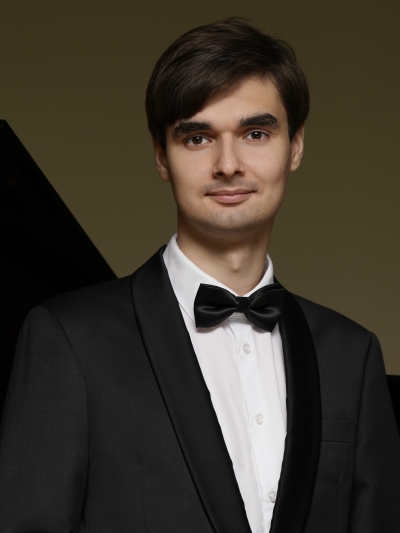
“Music has been part of my life from the very beginning.”
Alexander Martyanov was born in 2003 in Moscow. He completed his studies at the Chopin Children’s Music School (class of Olga Gruzdeva), and then continued his professional training at the Chopin Moscow State College of Musical Performance (class of Sergei Artsibashev). Since 2023, he has been a student at the Tchaikovsky Moscow State Conservatory, where he studies under the guidance of the Honoured Artist of the Russian Federation, Professor Andrei Pisarev, and the People’s Artist of the Russian Federation, Professor Nikolai Lugansky. In 2022, he was awarded First Prize at the Maestro International Competition (Gyumri, Armenia). In 2023, he became a First Prize laureate at the 8th International Piano Competition in memory of Vera Lotar-Shevchenko (Yekaterinburg). In 2026, he was awarded Second Prize at the International Competition Yamal Symphony (Yamal). He is actively engaged in concert performance activity. Since 2024, he has been participating in the programs of the Saint Petersburg Music House.
Saint Petersburg Music House (SPMH): What impressed you most about the Yamal Symphony Competition?
Alexander Martyanov: First and foremost, I was deeply impressed by the outstanding composition of the jury. What makes the Yamal Symphony Competition truly unique is that a single jury—made up of great musicians from different disciplines, including violinists, pianists, and cellists—serves across all categories. For me, it was, of course, an immense honor to take part in a competition of such a high level. A strong sense of excitement was intertwined with an equally profound feeling of happiness. I was also struck by the exceptional organization of the competition—absolutely everything was thought through down to the smallest detail. Incidentally, the temperature outside at the time dropped to –40 degrees, which was highly unusual for all of us, especially for participants from China, but we were truly “warmed” by the care and attention of the Yamal organizers and volunteers.
SPMH: In the second round, you performed a free program. Why did you choose Liszt’s Sonata?
Alexander Martyanov: Liszt’s Sonata is one of my favorite works. Its complex “Faustian” programmatic content, combined with its monumental, continuous sonata form, creates a musical canvas of extraordinary complexity, demanding from the pianist the highest level of technical mastery and considerable physical endurance. It is one of the greatest examples of a Romantic work in the fullest and highest sense of the word. I am very glad that I decided to include this Sonata in the competition, although I must honestly admit that I had some doubts, since I had never performed it before—so my appearance in the second round was, in fact, a premiere for me.
SPMH: The third round featured Rachmaninoff’s Second Concerto. After its premiere in 1901, critics particularly noted that the piano does not function as a dominant instrument, but rather as “first among equals,” and they could not agree on whether this was an advantage or a drawback. What is your view, especially in the context of a competition?
Alexander Martyanov: This is something that could be discussed at great length. I agree with the critics of that time who pointed to Rachmaninoff’s compositional innovation, namely the complete fusion of the orchestra and the piano into a unified whole. At the same time, I would like to offer not a strictly professional, but rather an illustrative analogy. The expression “first among equals” takes us back to Ancient Rome during the era of the Principate, specifically to the reign of the first Roman Emperor, Gaius Octavian Augustus. The phrase itself was, in a sense, a form of disguise: formally, he was merely the leading senator among supposedly “equal” peers, while in reality he held the decisive and determining power in governing the Roman state. In much the same way, the role of the piano in this concerto remains fundamental and defining, because it is the pianist who ultimately shapes the form, the tempo, the rhythmic drive, the emotional intensity, and much more. I would like to express my sincere gratitude to Maestro Ivan Nikiforchin and the Moscow State Academic Symphony Orchestra for giving me the opportunity to experience the great joy of a true creative partnership and to perform this immortal masterpiece.
SPMH: Last summer, you took part in the master classes of the Saint Petersburg Music House in Nizhnyaya Oreanda. Did the experience of this Summer Academy help you later on?
Alexander Martyanov: This experience was extremely valuable and important for me. First of all, I was given the rare opportunity to study with the outstanding teacher Miroslav Vinaevich Kultyshev—an exceptional musician with immense erudition and a remarkably refined musical sensitivity. Secondly, I had the opportunity to perform several works in front of an audience at concerts in Yalta and to receive invaluable advice from the distinguished musician and Artistic Director of the Saint Petersburg Music House, Sergei Pavlovich Roldugin, to whom I am deeply grateful for the unique opportunity to take part in the Summer Academy. And all of this took place surrounded by the natural beauty of what is truly a paradise-like setting—Nizhnyaya Oreanda.
SPMH: What were your first music lessons like in childhood? How did everything begin?
Alexander Martyanov: Music has been part of my life since birth. My mother is a pianist, a student of the People’s Artist of the Russian Federation Alexei Grigoryevich Skavronsky, a wonderful representative of the old school, a musician with a rich, beautiful sound and a remarkable technique, and himself a student of Grigory Romanovich Ginzburg. At that time, my mother was working with the brilliant vocal pedagogue and future head of the Bolshoi Theatre’s Young Artists Opera Program, Dmitry Yuryevich Vdovin, so our home was filled with constant rehearsals with singers. At the age of six, I was taken to the Chopin Music School, where the outstanding piano teacher Olga Alexeyevna Gruzdeva still teaches today—a class I had dreamed of joining. Incidentally, I later learned that Miroslav Kultyshev’s school teacher, Zora Mendeleevna Tsuker, had studied together with my own teacher in the class of Professor Alexander Eidelman at the Lviv Conservatory.
SPMH: How do you approach working on a new piece? How do you search for the right imagery?
Alexander Martyanov: Working on a new piece is a complex process, one that is deeply individual for every musician. It involves many different aspects, the ultimate goal of which is to grasp the composer’s intention—his “will,” so to speak. As for finding the imagery, I believe this can be approached in many different ways. I feel particularly close to the concept of Lev Semyonovich Vygotsky regarding “intelligent emotions.” The essence of his theory is that feelings develop in inseparable connection with intellect and consciousness, which means that the work on a new composition unfolds in a comprehensive and integrated way. My experience in the theatre also helps me greatly: I work at the Stanislavsky and Nemirovich-Danchenko Moscow Academic Music Theatre, where I observe opera and ballet performers, and I constantly find many things that are important and useful for myself.
SPMH: What shapes the individuality of an artist?
Alexander Martyanov: This is a very interesting and complex question. If I were to answer briefly—your individuality is essentially a reflection of who you are. I am very grateful to my teacher Andrei Alexandrovich Pisarev, who helped me understand, in this sense, “who I am.” I feel very close to his manner of being on stage: it is noble and extremely restrained in outward effects. Nothing distracts the listener from the essence of the music itself. I have read that Sergei Vasilyevich Rachmaninoff and Alexander Ilyich Siloti worked in a similar way. This approach resonates with me, although I should add that it is a deeply personal matter.
SPMH: Could you tell us about your interests outside of music?
Alexander Martyanov: My interests are quite simple: languages, history, football, and, of course, the theatre—especially ballet, which I absolutely adore. It is no coincidence that at different stages of my life, mainly in childhood, I dreamed of becoming a simultaneous interpreter, then a historian, and even a footballer (which, incidentally, was completely unrealistic because of my height).
SPMH: Among your upcoming performances are concerts within the Saint Petersburg Music House project Musical Team of Russia at the Tula Philharmonia, followed by appearances at the Saint Petersburg Philharmonia. The project, in general, has an extensive touring schedule. In your opinion, what makes this project unique? And how would you like to develop this collaboration further?
Alexander Martyanov: Without any exaggeration, I can say that with the appearance of the Saint Petersburg Music House in my life, everything changed fundamentally. This project has given me a unique opportunity to perform in the finest concert halls of the country, to work with outstanding orchestras and conductors, and to gain invaluable stage experience. For example, after The River of Talents, I traveled to Ulyanovsk to perform Rachmaninoff’s Second Concerto with the Ulyanovsk Symphony Orchestra “Gubernatorsky”. It was my debut, and I am deeply grateful to the conductor Andrei Efimovich Danilov for the invaluable advice he gave me as a young performer—advice that later helped me greatly at the Yamal Symphony Competition. I very much look forward to future concerts within the Musical Team of Russia project.
Interview by Tatyana Mikhailova.