“Every truly talented performance reveals a new facet of beauty”
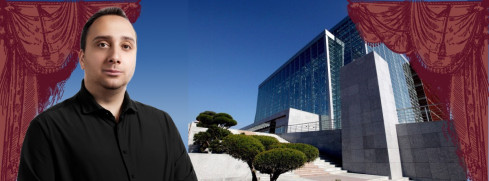
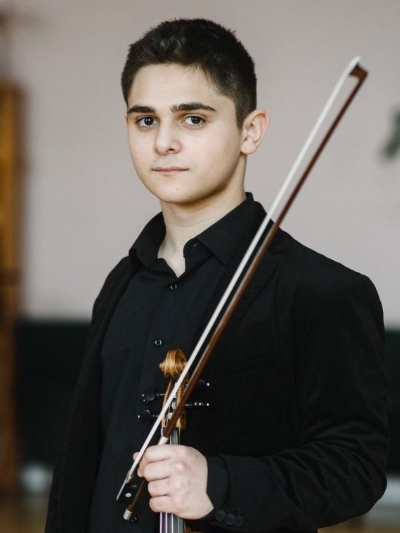
Emil Ildirekov was born in 2007 in Saint Petersburg. He began his musical education at Children’s Music School No. 34, where he studied in the class of Tatyana Gishyan. Since 2016, he has been a student of the Secondary Special Music School of the Saint Petersburg State Conservatory named after N. A. Rimsky-Korsakov, studying under the guidance of Larisa Baranova. In 2019, he became a laureate of the First Prize at the 8th International Competition of Youth Performing Arts named after Georgy Sviridov (Saint Petersburg). In 2020, he was awarded the First Prize at the All-Russian Open Competition-Festival of Performing Arts named after M. M. Ippolitov-Ivanov (Moscow). In 2021, he received the First Prize at the 5th International Performing Arts Competition "Elite International Music Competition" (online). In 2022, Emil Ildirekov became a laureate of the First Prize at the 9th Demidov International Youth Violin Competition "DeMYuKS – IX" (Yekaterinburg). In 2023, he was awarded the First Prize at the International remote music competition dedicated to the 150th anniversary of the birth of Sergei Rachmaninoff. In 2024, he received the Second Prize at the 21st International Competition of the Central Music School "In Tribute to L. B. Kogan" (Moscow). In 2025, he became a laureate of the First Prize at the 7th All-Russian Competition of Young Musicians "Constellation" (Sirius). He is a recipient of the "Young Talents of Russia" award (2021), a scholarship holder of the International Maestro Temirkanov Foundation (2021), and a scholarship holder and participant in the concert programs of the "New Names" Foundation (2022, 2023, 2024). In 2023, he was awarded a personal scholarship of the instrumental soloists’ competition "Light of Hope" of the Vladimir Spivakov Foundation. In 2022, he took part in concert performances within the framework of the Days of Russian Spiritual Culture in Paris.
Emil Ildirekov: The year 2025 became a period of intense growth and vivid stage experiences for me. I was fortunate enough to win at the "Constellation" competition, and immediately after that I was invited to the Summer Academy of the Saint Petersburg Music House in Crimea, where I was the youngest participant. This was both deeply inspiring and highly demanding, as it required me to give absolutely everything I had.
I performed at a number of important venues, including the concert halls of the Saint Petersburg Music House. Among all these appearances, one concert stands out in a very special way — the performance on September 17. On that day, one of my most cherished dreams came true: I performed Pyotr Ilyich Tchaikovsky’s Violin Concerto in its entirety — a work I have loved since childhood for its depth, its dramatic intensity, and its extraordinary beauty.
That evening is etched in my memory not only because of the excitement of appearing before an audience, but also because of an astonishing feeling of unity with the music itself, when every single note seemed to become a part of me. It was a moment of genuine creative revelation, one that will forever remain in my memory as one of the most significant milestones of my musical journey.
Saint Petersburg Music House (SPMH): What do you remember most vividly about the Summer Academy of the Music House in Crimea?
Emil Ildirekov: The Summer Academy in Crimea is a unique synthesis of intensive study and an inspiring, almost festive atmosphere. I met many fascinating people there, some of whom have even become close friends. We worked with outstanding teachers, took part in master classes, and performed at open-air concerts. The main result for me was not only the improvement of my technical skills, but also the formation of new creative connections. Each time I return home, I am accompanied by the persistent thought of how fortunate I am to be part of all this.
SPMH: Which works that you performed brought you victory at the 7th All-Russian Competition of Young Musicians “Constellation” in Sirius?
Emil Ildirekov: It is difficult to single out just one piece — each round was unique in its own way. I believe that it was the overall combination of all the rounds that ultimately led to my victory. However, one work from the second round stands out in my memory in a special way — the virtuosic piece “La Molinara” by Niccolò Paganini, which is rarely performed due to its exceptional technical difficulty. This composition contains almost every conceivable type of violin technique. Yet beyond technique, we must never forget that we are playing music. The real challenge lies in not getting trapped in purely technical details, but in truly making music. I believe that this, above all, allowed me to express myself more vividly and convincingly.
SPMH: How did the year marking the 185th anniversary of Tchaikovsky pass for you?
Emil Ildirekov: Pyotr Ilyich Tchaikovsky is one of my favorite composers, and I was truly happy to perform his works on such a significant anniversary. This year was especially meaningful for me as a performer. I had the opportunity to immerse myself deeply in Tchaikovsky’s artistic world, performing his music at various concert venues. Of particular importance to me was the performance of the Violin Concerto, in which I strove to convey the full depth and emotional richness of the music of this great composer.
SPMH: How do you feel about rare repertoire works? Do you have any “underperformed” or little-known pieces in your repertoire?
Emil Ildirekov: It so happened that my teacher often assigned such works to me. That is why I genuinely love repertoire rarities — they allow one to step beyond familiar expectations and to reveal something new to listeners. For example, while everyone else was performing Rondo Capriccioso by Camille Saint-Saëns, I was playing Rondo Capriccioso by Felix Mendelssohn in an arrangement for violin and piano by Abram Yampolsky, as well as the Valse-Caprice by Franz Schubert / Franz Liszt in an arrangement by David Oistrakh.
SPMH: How did your musical life begin? Who brought you to music school?
Emil Ildirekov: Everything began with my father’s dream. He loved music deeply, but never had the chance to pursue it himself because he simply did not have that opportunity. “Shall we go to music school?” he once suggested. I agreed without hesitation. My mother, however, was against it. Her own experience as a violinist told her very clearly that this is a path where behind every beautiful sound there are thousands of hours of hard work. Still, she did not try to stop me — and during the first years she immersed herself in music together with me, helping me with my practice and studies.
My greatest good fortune was meeting the ideal first teacher — Tatyana Mikhailovna Gishyan. It was she who showed me that music is not an obligation, but a joy. From that moment on, my future profession ceased to be a question at all.
From the second grade onward, I have been studying at the Secondary Special Music School of the Saint Petersburg State Conservatory named after N. A. Rimsky-Korsakov, in the class of Larisa Alexandrovna Baranova, where I continue to grow not only as a musician, but also as a person.
SPMH: When learning a new piece, which tasks are more difficult for you to solve — technical ones or musical ones?
Emil Ildirekov: Everything depends on the piece itself. If, for example, you are working on the Cadenza by Émile Sauret, the primary task is, of course, technical mastery. However, as someone who strives to be not merely a violinist but a true musician, I always aim to combine technical work with a deep and thoughtful understanding of the music. After all, these aspects are inseparable. I believe that this is how one should work on almost any piece: if you are unable to play cleanly and with a beautiful tone, it becomes extremely difficult to convey any inner musical ideas at all.
SPMH: Do you have musical idols among composers or performers?
Emil Ildirekov: The musical palette is far too rich to limit oneself to a single name. Every truly talented performance reveals a new facet of beauty.
SPMH: How did you first become acquainted with the Music House and its projects? And what will you be performing at the first concert of the new year within the Evenings in the English Hall series, dedicated to the 20th anniversary of the Saint Petersburg Music House?
Emil Ildirekov: The Saint Petersburg Music House is widely known, and when I learned that a selection process was being held, I made the decision to participate without hesitation.
For the 20th anniversary concert, I will be performing Variations on an Original Theme by Henryk Wieniawski. This work is distinguished by its vivid musical imagery: in the Variations, Wieniawski combines romantic expressiveness with elements of folk stylistics. Each variation represents a self-contained microcosm with its own unique atmosphere, offering broad scope for artistic interpretation. There is also an important historical dimension: Henryk Wieniawski is a key figure in the history of nineteenth-century violin art. Performing his composition becomes a kind of dialogue with tradition and emphasizes the continuity of musical eras within the anniversary program.
SPMH: Have you already planned your musical program for the new year?
Emil Ildirekov: In the near future, I will be applying to a conservatory. Therefore, my program will ultimately take shape depending on my future teacher. Nevertheless, I have already begun working on new pieces and plan to continue expanding my repertoire.
Interview by Tatyana Mikhailova