“I am hopelessly and endlessly in love with the clarinet”
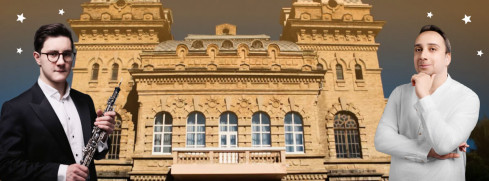
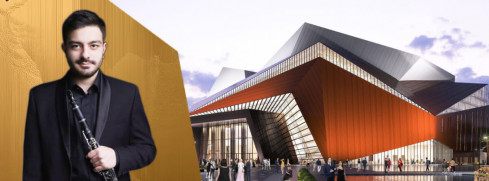
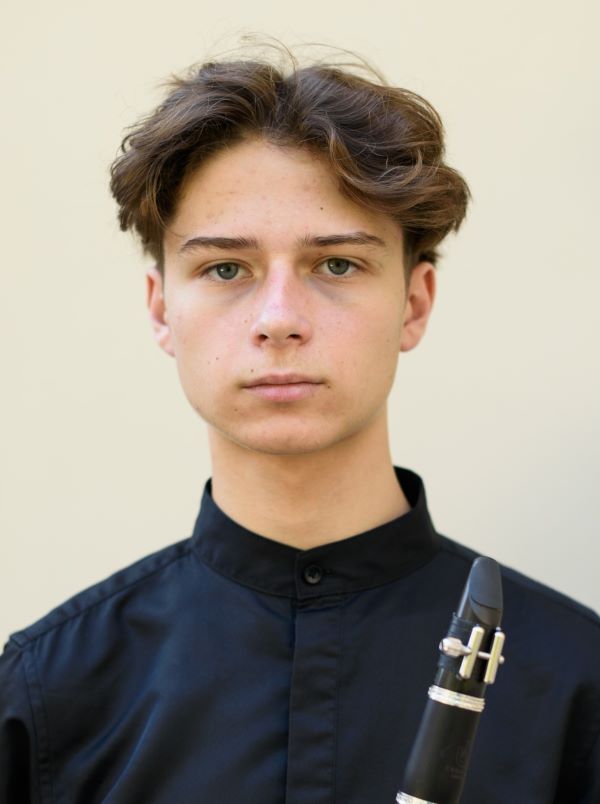
Igor Smaliy was born in 2006 in Moscow. He graduated from the Central Music School – Academy of Performing Arts (class of the international competition laureate and teacher Igor Fedorov). Since 2024 he has been a student of the Tchaikovsky Moscow State Conservatory (class of the Honoured Artist of Russia, Professor Evgeny Petrov). In 2022 he became a laureate of the Second Prize at the International Youth Music Competition dedicated to the 140th anniversary of the birth of Igor Stravinsky (Saint Petersburg) and a laureate of the First Prize at the 7th International Music Competition “GoodWin Art – The Art of Winning” (Moscow). In 2023 he was awarded the Grand Prix at the All-Russian Competition of Young Musicians “Constellation” (Educational Center “Sirius”) and became a laureate of the First Prize at the 15th International Competition “Golden Talents” (Kursk). Since 2020 he has been a scholarship holder of the “New Names” Foundation, and in 2024 he became a laureate of the foundation’s competition for scholarship recipients. A participant in the concert and educational programs of the Saint Petersburg Music House since 2023.
Igor Smaliy: My interest in music was first noticed by my mother. Being a musicologist by profession, she became my first and most important mentor. In childhood I greatly enjoyed learning songs and singing them. At the age of six she took me to the preparatory department of the Central Music School attached to the Tchaikovsky Moscow State Conservatory. At that time I was far too young to have any preferences of my own and did not even know the names of musical instruments, so my mother helped determine the choice (fortunately, I have never once regretted that the clarinet was chosen). She believed that among the wind instruments the clarinet possesses the most flexible timbre, virtually unlimited virtuoso possibilities, and the ability to perform in a wide variety of styles. In addition, the competition among clarinetists is not as intense as it is among pianists or violinists. From that moment on, I have been hopelessly and endlessly in love with the clarinet.
Saint Petersburg Music House (SPMH): What associations does the voice of the clarinet evoke for you? When you work on sound, what kind of effect are you striving to achieve?
Igor Smaliy: For me, the sound of the clarinet is the expression of my emotions, experiences, and thoughts. It can sound soft, warm, and enveloping, or it can become sharp, formidable, and piercing. The technical possibilities of the clarinet are virtually limitless, and its timbre is incredibly flexible. For example, thanks to such modern techniques as slap, multiphonics, and frullato, the sound and timbre can become fantastical, almost unrecognizable. My main goal is not simply to play the notes, but to make the clarinet speak, to convey an emotion to the listener and leave them deeply affected. The sound cannot be uniform or sterile; it must touch something alive inside the listener. I strive for the widest possible diversity of timbral and sonic color. Depending on the intention, the clarinet can cry out, whisper, sing, or chirp. And my aim is to ensure that the listener leaves the concert infected with the very emotion that I have invested in my performance.
SPMH: How long are you able to rehearse? And what should one do when inspiration disappears?
Igor Smaliy: It is impossible to give a definite answer to that question. The amount of time I am able to practice or rehearse varies greatly at different times. There are days when I only manage to warm up briefly. This usually happens when I have been traveling for a long time, for example while on tour, or when the day is filled with several long rehearsals and by evening I simply no longer have the physical strength to continue practicing. On such days I may run through the concert program in my mind, mentally working through individual passages. At the moment there are times when I play as much as ten hours in a day, including rehearsals, concerts, and personal practice. Yes, there are moments when I become physically tired from such an amount of work, but emotionally I will never grow tired of music. Even when I have had a difficult day with several rehearsals and a concert, in the evening, after leaving the hall, I put on my headphones and continue listening to music. As Pyotr Ilyich Tchaikovsky once wrote: “Inspiration is a guest who does not always come at the first call. Meanwhile one must always work, and a true, honest artist cannot sit with folded hands under the pretext that he is not in the mood. If one waits for the mood and does not attempt to move toward it, it is easy to fall into laziness and apathy. One must endure and believe, and inspiration will inevitably come to the one who has managed to overcome his reluctance.” In this I fully agree with Pyotr Ilyich. In my practice and in my work I try to find a balance. After all, it is important to allow oneself time to rest, although within a busy concert schedule it is often difficult to carve out even a single day in which to relax and regain one’s strength. Of course, when you are exhausted both physically and emotionally, practice will not only bring no benefit but may even cause harm. Many great musicians have injured their hands in the pursuit of perfection. It is important to treat one’s health—both physical and mental—with great care.
SPMH: What are the most important lessons—understood in the broadest sense—that you have received from your teachers?
Igor Smaliy: I have been fortunate to study with many remarkable musicians. The path of a musician is a continuous process of learning, and the broader the palette of impressions and experiences, the more we are able to express through our music. I always try to absorb the very best from each mentor in order to develop the widest possible perspective on music and performance. My first teacher, Oleg Igorevich Tantsov, laid the foundation of my love for music—he taught me the basic principles of clarinet playing and instilled in me a sense of independence. I studied with Igor Petrovich Fedorov for only two years, but during that time he showed me what a meticulous, almost jeweler-like approach to every detail of a musical work truly means. With him I learned how to create on stage a vivid, charismatic, and memorable artistic image. At present I am studying at the Tchaikovsky Moscow State Conservatory under Evgeny Alexandrovich Petrov. Evgeny Alexandrovich is a teacher with a very multifaceted approach to musical interpretation; he often speaks not only about the technical aspects of performance but also about the performer’s inner state and the psychophysiological dimension of the process. I have been very fortunate to study with the very best, and from each of them I have tried to take something uniquely my own.
SPMH: Which works from the world clarinet repertoire are closest to you?
Igor Smaliy: I always find it very difficult to answer questions of this kind: who my favorite composer is, what my favorite piece is, or who my favorite performer might be. My preferences change rather quickly. My favorite piece is always the one I am performing at the moment. Before playing a work by a composer, I need to fall in love with that composer’s music and try to understand what he wanted to express and how he wanted his work to sound. I greatly admire the classical concertos that form the core of the clarinet repertoire—Weber, Mozart, Spohr; but at the same time I adore modern works as well: Nielsen, Copland, Widmann, Boris Tchaikovsky. I cannot say that I love one more than the other. Each time I perform a particular piece, I fall in love with it all over again.
SPMH: How do you relate to new music, contemporary composers, and various collaborations involving classical music?
Igor Smaliy: It is always fascinating to perform the music of a contemporary, especially a composer with whom you live in the same era, the same country, and sometimes even the same city. There is an opportunity to meet and speak with the composer, to ask what ideas he placed into his work and whether my interpretation resonates with him.
Once I had an interesting experience. In the autumn of last year I performed “Orchestrania” by the remarkable contemporary composer Efrem Iosifovich Podgaits as part of the State Kremlin Orchestra of the Presidential Administration under the baton of Konstantin Yuryevich Chudovsky. The piece features a rather demanding solo clarinet part filled with numerous modern techniques. The composer himself attended the concert. After the performance I happened to meet Efrem Iosifovich backstage, and we had an engaging conversation.
E.I.: A wonderful concert, it turned out magnificently. All the multiphonics, the frullato—marvelous! With whom are you studying?
Me: With Evgeny Alexandrovich Petrov at the Conservatory.
E.I.: Excellent! I know him. And who was the clarinetist when we made the first recording… Ah, I remember now! Tantsov!
As it turned out, the first performer of “Orchestrania” had been Oleg Igorevich Tantsov—my very first teacher. So, quite by chance, many years later I repeated the premiere that my teacher had once given.
SPMH: Your first spring concert within the Saint Petersburg Music House project Musical Team of Russia will take place on March 6 in Sirius, Sochi. Weber’s Concertino is a work without which no clarinetist’s repertoire is complete. What attracts you most in this composition and in this composer?
Igor Smaliy: Yes, on March 6 there will be a concert where, together with the wonderful cellist Bogdan Efremov, we will perform with the Russian National Youth Symphony Orchestra under the direction of Fyodor Mikhailovich Beznosikov. Bogdan will perform Pyotr Ilyich Tchaikovsky’s Variations on a Rococo Theme for Cello and Orchestra in A major, Op. 33, while I will play Carl Maria von Weber’s Concertino for Clarinet and Orchestra in E-flat major, Op. 26. For me it is always an immense joy to take part in concerts organized by the Saint Petersburg Music House. I am deeply grateful to Sergei Pavlovich Roldugin for the opportunity to perform on the finest concert stages of our country. Each time I perform well-known clarinet works such as Weber’s Concertino—part of the “golden treasury” of the clarinet repertoire—I feel my responsibility as a kind of intermediary between the composer’s intention, his creation, and the listener. There are many technically demanding contemporary works, but the most difficult pieces to perform are always Mozart, Weber, and Brahms. When you perform music by such great composers and step onto the stage, your heart tightens every time, because you feel the presence behind you of a whole constellation of great clarinetists who have performed these same works before you. At the same time, I experience a joyful sense of inspiration from knowing that through my own performing abilities, knowledge, and both artistic and life experience, I can contribute a small part of my own soul to the birth and continuing life of a musical work.
SPMH: What prospects does participation in the Musical Team of Russia project open for you?
Igor Smaliy: For me it is an immense joy and a great honor to take part in the projects of the Saint Petersburg Music House. There is simply no equivalent to the *Russian National Music Team* in our country. It is an extraordinarily large-scale project that encompasses many different cities across Russia, presents instruments that are only rarely heard as solo instruments, and brings together some of the finest young musicians—something of this scale and level cannot be found elsewhere. I have taken part in various festivals and foundation programs, but none of them can even come close to the scope and professionalism of the Music House. It was precisely with the Music House that I first went on international tours (Chennai, India), and it was within its projects that I performed on such stages as the Tchaikovsky Concert Hall, the Mariinsky Theatre, the Nikolaevsky Palace, as well as in many cities throughout Russia. It is thanks to Sergei Pavlovich Roldugin and the Saint Petersburg Music House that my career as a soloist began and continues to develop.
SPMH: The creative collaboration between Weber and Bärmann, for whom he wrote a number of works, produced remarkable results. If you were to imagine such a partnership, with which composer might you form a similar creative tandem?
Igor Smaliy: The very first collaboration between Weber and Bärmann resulted in the Concertino for Clarinet and Orchestra, which Bärmann performed brilliantly at one of Weber’s author’s concerts in Munich. The success of that work prompted the musician to commission from the composer two concertos for clarinet and orchestra, which were written shortly thereafter, in 1811. Interaction with such a distinguished clarinetist helped Weber gain a deeper understanding of the instrument’s technical possibilities and employ them to the fullest extent. In particular, the composer made use of the entire range of the clarinet, including its low register, which earlier composers had only rarely explored.
My dream would be for Sergei Vasilyevich Rachmaninoff to have written something solo for the clarinet. His music, both chamber and symphonic, possesses extraordinary power and leaves an indelible impression. In Rachmaninoff’s symphonies and piano concertos there are exceptionally beautiful solo clarinet passages. I could also dream that Tchaikovsky and Ravel might have written solo concertos for the clarinet. Such works would represent a significant contribution to the solo clarinet repertoire. Quite often a composer’s fascination with a particular instrument arises from acquaintance with a distinguished performer. In this way Wolfgang Amadeus Mozart wrote for Anton Stadler, and Johannes Brahms for Richard Mühlfeld. I would be very happy if one day I could reveal the full potential of my instrument to a contemporary composer in a similar way.
SPMH: One of your major achievements is connected with the Sirius Educational Center—the Grand Prix at the All-Russian Competition “Constellation.” Did this competition change your life?
Igor Smaliy: Yes, the All-Russian Competition *Constellation* truly changed my life. My participation in the projects of the Saint Petersburg Music House began precisely because of that competition. It was at *Constellation* in 2023 that Sergei Pavlovich Roldugin first “noticed” me. The competition became a kind of springboard for me and gave an enormous impetus to the development of my musical career. I have probably been to Sirius more than ten times by now. Each time I return there for chamber or symphonic concerts, I recall how I first came here for master classes and later for the competition itself. Sirius has become almost like a home for me; it is associated with a tremendous number of warm memories, and I always feel great joy when I return there.
SPMH: Studies at the conservatory, competitions, performances, and tours—how do you manage to maintain balance and still leave a little time for something beyond music?
Igor Smaliy: I believe that a musician should be a well-rounded individual. The breadth of what one has seen and heard, one’s life and creative experience, inner conflicts and emotional experiences—all of this makes a performance meaningful and unique. It is often difficult to carve out even a couple of hours to read a book, visit a museum, or do sports, but I still try to maintain that balance.
SPMH: Last summer, within the framework of the Music House project The Embassy of Musical Mastery, you performed at the Russian House in Chennai, India. How do you feel about this kind of touring format?
Igor Smaliy: I was absolutely delighted by the tour to India. These were my first serious international гастроли, and everything went wonderfully. Just like The Russian National Music Team, The Embassy of Musical Mastery is a project that has no equivalent in Russia. At the Russian House in Chennai I performed the Fantasy on Themes from the ballet “The Nutcracker” for clarinet and piano, as well as the Russian Dance from the ballet Swan Lake by Pyotr Ilyich Tchaikovsky. This kind of touring format allows one to become acquainted with the culture of the country.
SPMH: Which of the great musicians serves as an ideal for you?
Igor Smaliy: For me, the true ideals are the great composers: Mozart, Rachmaninoff, and Stravinsky. In many ways they were innovators who were not afraid of criticism or condemnation. Sergei Vasilyevich Rachmaninoff, for me, represents the ideal of a Russian composer who, even while living far from his homeland, remained profoundly and authentically Russian. What is especially astonishing is the scale of this man’s genius—Sergei Vasilyevich was at once a great composer and, at the same time, a brilliant pianist of his era who helped establish the global prestige and leadership of the Russian piano school. Wolfgang Amadeus Mozart is an ideal musician for me because his music unites deep artistic substance with a form that is simple yet perfectly crafted. Igor Fyodorovich Stravinsky, in turn, represents for me a model of tireless dedication to work. The composer lived a long life and in his творчество brought together the finest traditions of Russian classical musical art with the new currents that shaped the music of the twentieth century. His music is extraordinarily original and vividly distinctive. Performing Stravinsky’s works is always fascinating, and both the orchestral and solo clarinet parts in his music are among my favorites.
Interview by Tatyana Mikhailova.