“The violin is my greatest love and the work to which I shall devote my entire life!”
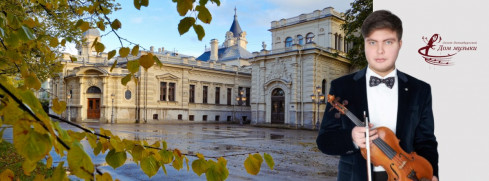
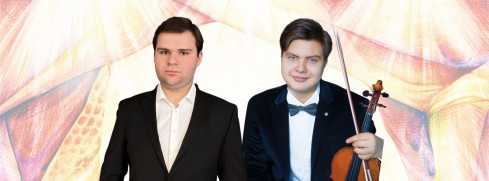
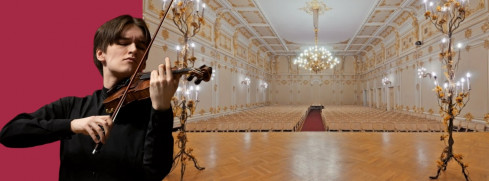
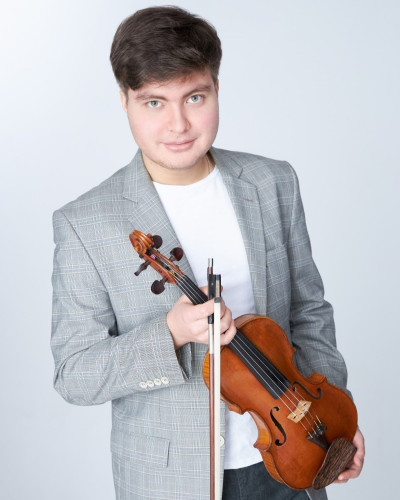
Alexander Papushev was born in Ussuriysk, in Primorsky Krai, in 2004. He studied at the Children’s Music School in Ussuriysk, where he was taught by Galina Kopylova. He is a graduate of the Central Music School – Academy of Performing Arts, where he studied under Professor Sergei Kravchenko, Honoured Artist of the Russian Federation. Since 2022, he has been a student at the Moscow State Tchaikovsky Conservatory, continuing his studies with the same teacher. He has won leading competitions for young musicians, including the Ninth “Città di Pesaro” International Music Competition (Italy, 2012) and the Sixth Professor Mirosław Ławrynowicz International Competition for Young Violinists (Poland, 2015). In 2018, he was awarded the Grand Prix at the Tenth International Competition for Young Musicians and Performers in Vladivostok, and in 2020 he won the M. M. Ippolitov-Ivanov All-Russian Open Competition-Festival of Performing Arts in Moscow. In 2022 and 2026, he was awarded Second Prize at the Fourth and Fifth All-Russian Music Competitions in Moscow respectively. He has been a participant in the programmes of the Saint Petersburg Music House since 2021.
SPMH: In October, you became a prize-winner at the All-Russian Music Competition. Would you tell us about that experience?
Alexander Papushev: The All-Russian Music Competition is an event of national importance. The atmosphere was celebratory, creative and exceptionally friendly. Even at moments of considerable tension, that positive spirit remained. The competition took place over three rounds, with the auditions held at the Moscow State Tchaikovsky Conservatory. I would particularly like to acknowledge the professionalism of the organisers: the convenient scheduling, excellent technical support and clear provision of information. I would also like to offer a special word of thanks to the members of the jury for the objectivity of their assessments. It is worth emphasising that the competition was fierce and the field of contestants very strong. Yet my principal rival is always myself. What mattered was shifting my attention towards my own preparation, overcoming my nerves and finding a sound that was truly my own. The result of the draw came as a surprise: I drew number 24, the final place in the running order, which I regarded as an advantage. Nevertheless, I had to change my plans and my flight tickets so that, after performing in the first round on 1 October, I could reach Vladivostok in time for a concert at the Philharmonic on 2 October, then return to Moscow that same night and perform in the second round of the competition. And, of course, performing with an orchestra in the final at midnight in the Tchaikovsky Concert Hall was an extraordinary experience… I was deeply impressed by the appreciative audience: their applause, admiration and support were a source of inspiration to me. All in all, taking part in a competition of this kind provides a powerful impetus for growth.
SPMH: How did you work towards this success? Who helped you prepare the programme? What part did the Saint Petersburg Music House Summer Academy in Sochi play in your preparation?
Alexander Papushev: The lessons I attended at the Saint Petersburg Music House Summer Academy played the principal role in my preparation for the competition. I would like to express my profound gratitude to Tatiana Berkul, who so generously shared her experience and knowledge during this particular period of preparation for the All-Russian Music Competition. Patiently, painstakingly and with exacting standards, she introduced me to the subtleties and secrets of the violinist’s art, and that undoubtedly helped me to prepare. My teacher, Sergei Kravchenko, Professor at the Moscow State Tchaikovsky Conservatory and Honoured Artist of the RSFSR, shaped the programme and devised the preparation strategy, planned my workload, monitored my progress, analysed mistakes and kept me motivated; he also lent me his own bow and violin for the duration of the competition. My particular thanks go to Sergei Pavlovich Roldugin for the opportunity to participate in the programmes of the Saint Petersburg Music House, for his well-founded, constructive and objective criticism, and for his words of encouragement and invaluable advice.
SPMH: This is not your first prize at the country’s foremost national competition: you achieved a similar result in 2022. What is your attitude towards competitions?
Alexander Papushev: Yes, indeed, in 2022 I became a prize-winner at the country’s foremost national competition. I then faced the question of whether to take part again in 2026. If the answer was “yes”, then “why”? Naturally, before anything else, I tried to give myself an honest answer. 1. It was a chance to demonstrate that I was continuing to develop and to compete for a higher award. It was an opportunity to demonstrate the standard I had reached to my teachers, the jury and the public. 2. I wanted to broaden my repertoire and try a different programme. After taking part for the first time, I understood which works best revealed my own performing style. 3. It offers valuable experience: an opportunity to examine my strengths and identify areas for further development with the help of more experienced specialists. 4. My personal growth was another reason. I simply feel that, in the time that has passed, I have come to play better and with greater confidence. For me, competitions are always about the direction of my own development: they provide a powerful incentive to move forward and a test of my abilities.
SPMH: Which of your performances is your favourite?
Alexander Papushev: In childhood, everything we experience seems brighter, richer and more like a fairy tale. On 1 June 2015, I performed at the Moscow International House of Music. The concert took place as part of the Vladimir Spivakov Foundation’s Twelfth Moscow Meets Friends International Festival with the Kostroma Governorate Symphony Orchestra, conducted by Pavel Gershtein. I performed Bach’s Concerto. That day, I was presented with a violin by the Spivakov Foundation; the instrument remained at the Children’s School of Arts in my home town.
SPMH: How did you first find your way into music?
Alexander Papushev: When I was five, my grandmother, who had played the violin herself in her youth, decided to enrol me at music school. I became a pupil of Galina Kopylova. Those first lessons, which took the form of play, immediately showed me, young musician that I was, that playing this instrument was my calling. From an early age, I was actively involved in ensembles with older children and took part in competitions. By the age of seven, I had already won the Grand Prix at an international competition in Italy, performing Charles Dancla’s Solo de concert. A turning point came with my participation in the Nutcracker International Television Competition for Young Musicians in 2012–2013. Vladimir Spivakov noticed me, gave me a violin and awarded me a scholarship from his foundation. A year later, in 2013, I moved to Moscow and entered the Central Music School – Academy of Performing Arts to study under Professor Sergei Kravchenko, Honoured Artist of the Russian Federation. This was a significant step in my development as a professional musician.
SPMH: Were you called a child prodigy when you were young?
Alexander Papushev: People did sometimes say that, but I am not sure it was an entirely accurate description of me. Rather, it was my first teacher, Galina Kopylova, who remarked on the progress I was making in my violin studies. In my general schooling, I developed at my own pace: I achieved high marks in chemistry and biology in the Unified State Examination. In 2025, I enrolled at a medical university in Moscow, thinking that I might try my hand in another field, but now I can say with complete confidence that the violin is my greatest love and the work to which I shall devote my entire life! I also enjoyed taking part in sport. I have now completed a college course specialising in the horn, and I am a fifth-year student in the Faculty of Musicology.
SPMH: How would you define the Russian school of violin playing? And whom would you name as its principal teachers?
Alexander Papushev: The Russian school of violin playing is a multifaceted concept encompassing historical traditions, including national folklore; aesthetic principles, including the pursuit of expressiveness and emotional depth, and the seamless integration of technical perfection with artistic intention; and methods of performance and teaching within the art of violin playing in Russia. What distinguishes us is the lyrical quality of our playing, its vividness, sincerity and emotional intensity. This is what people call the “expansive Russian soul”. The “Russian school” is an extraordinary blend of East and West, in which their national traditions are all interwoven. Ivan Khandoshkin was one of its founding figures. Leopold Auer played an enormous part in shaping its traditions. During the Soviet period, Pyotr Stolyarsky and Abram Yampolsky played leading roles. Among their celebrated pupils were David Oistrakh, Nathan Milstein and Leonid Kogan. Among our contemporaries are Vladimir Spivakov, Sergei Kravchenko, Tatiana Berkul, Viktor Tretyakov, Mikhail Gantvarg, Vadim Repin, Maxim Fedotov and Pavel Milyukov…
SPMH: What is the most valuable advice you have received from your teachers?
Alexander Papushev: We encounter teachers at every turn: those close to us, our relatives, companions, friends, acquaintances, classmates, colleagues at work, neighbours and people we happen to meet by chance. Only now have I come to understand the value of everyone who has appeared in my life, even if only for a moment. Some have entered my life for a minute, others for no more than a couple of hours on a plane or in a café, for a few days or even a year… Yet they all arrive, leave their mark and then, in some strange way, disappear from my life. One taught me to be stronger, another to be wiser… the fifth simply broke me, but even that gave me experience… the fifteenth teaches me to forgive… the hundredth teaches me to be happy. How does that happen? The essential thing is to concentrate on what is genuinely good in each person we meet, to cultivate positive thinking and to learn from the experience: to change in ourselves whatever we disliked in someone else. We need to stop, slow down, ground ourselves and ask: what have I learnt from this person, and what can I learn through my interactions with them?
SPMH: Who is your favourite hero in music?
Alexander Papushev: My favourite is Prometheus in Scriabin’s The Poem of Fire. In Scriabin’s work, Prometheus symbolises the creative spirit that challenges the world. The music is built upon audacious harmonies and steadily mounting energy.
SPMH: How do you approach arrangements of well-known works? How do you rethink the colours, nuances and sonorities originally conceived by the composer?
Alexander Papushev: Working on arrangements is a creative process in which I rethink the music, revealing new facets of it through the possibilities offered by my instrument. The work begins with listening to the original, understanding its essence and analysing it. Then comes the search for technical solutions and the process of adaptation, with particular attention to fingering. The next stage is finding a sound that is “my own”. Working through the details is the most painstaking part of all: refining intonation, rhythmic precision and dynamics. At the final stage, I work on the score, marking bowings and fingerings to make the piece easier to perform. Yet one must strive to preserve a connection with the composer’s intentions while telling one’s own story, drawing upon the full range of expressive resources the instrument has to offer.
SPMH: On 18 November, at the Beloselsky-Belozersky Palace, you will perform Paganini’s Violin Concerto No. 1 as part of the Saint Petersburg Music House programme Young Interpreters of Russia. Its violin part, like those of his other concertos, has been compared to a role in a dramatic production. How do you work on this role? What is its central idea, and where do its difficulties and its beauty lie?
Alexander Papushev: When people say that the violin part in Paganini’s First Concerto is a “role in a dramatic production”, they are referring not to a theatrical production as such, but to the composer’s distinctive approach to the genre itself. In this music, the soloist becomes the central “character”. Paganini took the principle of “competition” between soloist and orchestra to its very limits. His Concerto contains many dramatic “utterances”: lyrical digressions and fantasy-like monologues. It is precisely those moments when the violinist seems to deliver a solo monologue, argue with the orchestra or burst emotionally through the silences that create the impression of a theatrical performance. Paganini brought together an entire arsenal of daring technical devices: scordatura, ricochet bowing, double stops and chords, harmonics, pizzicato, rapid passagework and arpeggios, stretches and leaps. Together, all these techniques create that very effect of a “dramatic production”: the music does not merely accompany, but quite literally lives, breathes and argues with the orchestra, revealing the soloist’s inner world. My choice of Paganini’s First Concerto with the cadenza by Émile Sauret was no accident, but a conscious artistic decision. For me, it represented a particular kind of challenge: a demanding and virtuosic composition for violin and orchestra, requiring the performer to possess technical command of the highest order, a sense of style and artistry. The cadenza by the French composer and violinist Émile Sauret has become a benchmark, a kind of “gold standard” for performers: it not only demonstrates the highest level of technique, but also fits seamlessly into the dramatic structure of the Concerto, creating a brilliant episode that is complete in itself.
SPMH: How would you interpret the figurative expression “the violin chooses its own musician”?
Alexander Papushev: I see two meanings in that expression. The first concerns early childhood, when a child arriving at music school is too young to make a conscious choice between the piano, the violin, the guitar or another instrument. Perhaps it is chance or fate that decides what this young person will go on to study. The second is “mystical”: it concerns the search for an instrument that is truly “one’s own”. That is probably a journey I have yet to make…
Interview by Tatyana Mikhailova