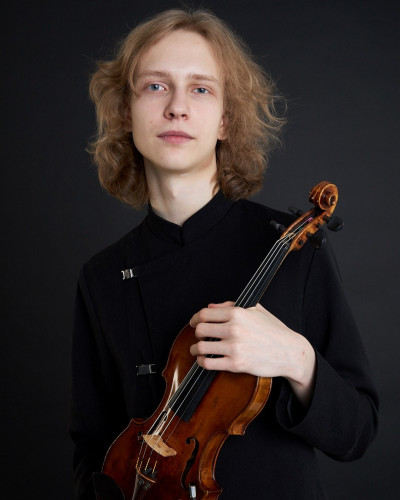
"As a child, I was captivated by the sound of the violin"
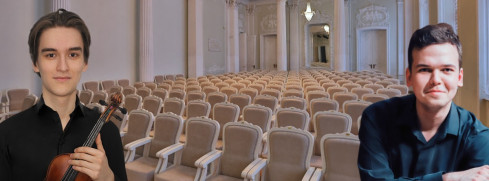
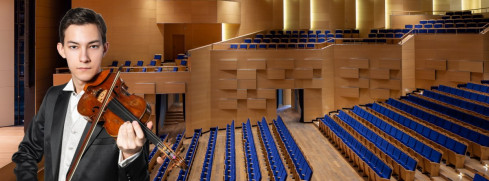
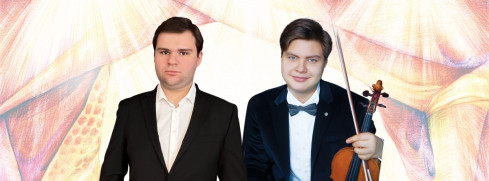
Aleksandr Poltoratskij was born in 2004 in the city of Podolsk in the Moscow Region. He graduated from the Moscow Gnessin Special School (College) of Music, where he studied in the class of Professor Tatiana Berkul, an Honoured Artist of the Russian Federation. Since 2023, he has been a student at the Moscow State Tchaikovsky Conservatory, continuing his studies with the same teacher. In 2022, he was awarded the Grand Prix at the Fourth Gnessin International Competition for Violinists and Violists in Moscow. In 2023, he won First Prize at the Grand Moscow Competition for String Instrument Performers and First Prize at the Tenth G. V. Sviridov International Competition for Youth Performing Arts in Saint Petersburg. In 2026, he was awarded Third Prize and a special prize at the 33rd Andrea Postacchini International Violin Competition in Italy. He also holds the title of “Best Student of 2022” from the Moscow Gnessin Special School of Music. He has been taking part in projects organised by the Saint Petersburg Music House since 2024.
Saint Petersburg Music House (SPMH): You began learning to play the violin at the age of four. How did your interest in this instrument develop when you were still so young?
Aleksandr Poltoratskij: At the age of four, of course, it was more a matter of an interest that developed through my family. My parents are not musicians, but my mother and my elder brother both completed their studies at a children’s music school, specialising in different subjects, while my grandmother frequently attended classical music concerts. It was my grandmother who enrolled me in violin lessons at Children’s Music School No. 2 in Podolsk, and I remain grateful to her for that to this day. As a child, I was captivated by the sound of the violin. It is an instrument of tremendous expressiveness and many different qualities: delicate and fragile, yet at the same time expansive and powerful, with an exceptionally rich range of colours and timbres. My family has always supported me in this pursuit and continues to do so. Because my mother wanted to help me receive a professional musical education, we moved to Moscow, where I changed schools and continued my studies at the Balakirev Children’s School of Arts before later gaining admission to the Moscow Gnessin Special School of Music.
PMH: Was your progress as a student an easy one, or were there times when you had to push yourself beyond your own limitations?
Aleksandr Poltoratskij: I do not think that any musician’s path can be described as entirely easy. Going out on stage, preparing for that appearance, working through difficulties and achieving the necessary result all involve pushing yourself beyond your limitations, but they also contribute to your professional growth, build your resilience and shape you as a musician. Behind a successful performance lie many hours of practice, searching and reflection: things that the audience will never see, yet these are precisely what make a true musician. It is particularly rewarding when, after a long period of work, you begin to feel, even if that feeling may be only fleeting, that something which seemed impossible not so long ago is finally beginning to come together.
SPMH: At the Gnessin School, you received the title of “Best Student of 2022”, which represents both a considerable achievement and a considerable responsibility. What emotions did you experience at the time?
Aleksandr Poltoratskij: It was a very welcome and unexpected form of recognition for me. I was then in my third year at the college, graduating from the Gnessin School and applying to the Conservatory; it was a very difficult year in every respect, and the award came as a breath of fresh air, bringing the realisation that all my efforts and hard work had not been in vain and, of course, giving me an incentive to keep moving forward and improving. After all, any prize or title is more than an assessment of what you have achieved at a particular moment: it also brings certain expectations for the future and sets a standard below which you can no longer allow yourself to fall. Without a doubt, much of the credit for this title belongs to my teachers.
SPMH: Your teacher, Tatiana Berkul, was a student of David Oistrakh. Does she tell her own students about him and his teaching methods, and perhaps use some of his approaches in her own teaching?
Aleksandr Poltoratskij: Yes, of course! Thanks to Tatiana Semyonovna, the name of David Fyodorovich is associated not only with the historical recordings and concert performances that we can all listen to today, but also with a living tradition of teaching. Tatiana Semyonovna tells us about him as a musician and a teacher, about his attitude towards his students, his approach to working on a piece and to the very sound of the instrument, and about what it was like to study in those days. Everything was much stricter at that time. There is a very warm, family atmosphere in Tatiana Semyonovna’s class: we often attend one another’s lessons, and we can always turn to her for help and advice, even on matters that have nothing to do with music. The relationships between the students and their professor are marked by warmth and humanity, and an atmosphere of trust and understanding prevails in the class, all thanks to Tatiana Semyonovna. Perhaps the most valuable thing here is the school of playing itself. It embodies a particular attitude towards music, towards the quality of sound, towards the process of working on a piece and, very importantly, towards the individuality of the performer: everything that David Fyodorovich passed down and that Tatiana Semyonovna instils in her pupils and students. It is a great honour and a source of pride to study with such a professional and musician, someone who carries forward the traditions of Oistrakh.
SPMH: Who serves as your principal point of reference in music?
Aleksandr Poltoratskij: I find it difficult to name just one person. Different musicians influence me at different periods in my life. Of course, there are performers whose recordings I listen to regularly and keep returning to, but my interests also change with the passage of time. Besides, different performers excel in different works and styles. Take, for example, the way Oistrakh played Mozart. If you were to take his recordings of the Mozart concertos as your model today, listeners and competition juries might have questions about that approach. There used to be a different manner of performing music of the Classical and Baroque periods, and people no longer play it that way today. You have to keep pace with the times, while avoiding the imitation of mannered or excessively free interpretations and remaining within the bounds of style and taste. I spend a great deal of time listening to and analysing different recordings and performances. When I am learning a new piece, I find a point of reference for myself: a performance by an artist in which there is much that resonates with me and that I admire, something towards which I would like to strive. Recently, these have been recordings by Maxim Vengerov, Augustin Hadelich, Julia Fischer, David Oistrakh, Leonid Kogan, Henryk Szeryngand Vladimir Spivakov.
SPMH: What did it feel like when you performed with an orchestra for the first time?
Aleksandr Poltoratskij: I first performed with an orchestra at the age of twelve, in the large hall of the Balakirev Children’s School of Arts. There was a tradition at the school of rewarding outstanding pupils with the opportunity to perform with an orchestra. On that occasion, it was the Moscow State Symphony Orchestra under the direction of Pavel Kogan, and I played Tchaikovsky’s Mélodie from Souvenir d’un lieu cher. When you first step out on stage with an orchestra, you experience an entirely different sense of scale. You are no longer alone on stage: there are a great many musicians around you, and the sound you produce together depends on your interaction with them. I remember being very nervous at the time. I wanted the performance to remain in the memory of the audience, as well as in my own as my first appearance with an orchestra; I wanted to succeed in conveying to the listeners the mood, the emotional state and all the beauty that Tchaikovsky had written into the music. An orchestra is a force of nature, and it seems to me that the soloist’s task is to become part of that force as harmoniously as possible, so that together they form a single whole.
SPMH: Which of your own performances has left you with the most vivid impressions?
Aleksandr Poltoratskij: It is probably difficult to single out just one performance, because each is associated with a particular period of my life and leaves memories of its own. But the concerts that stand out most vividly are those after which you feel that you have truly managed to say something through music. It does not necessarily have to be the largest concert hall or the most prestigious competition. What matters particularly to me are those moments when, after a performance, you realise that you have truly lived through the piece on stage, rather than simply played all the notes. Those are the performances that remain most firmly in the memory. Among my recent appearances, the most memorable was probably the concert in Tula in the “Musical Team of Russia” series, where Maestro Igor Gennadyevich Manasherov and I performed Shostakovich’s Concerto No. 1 for Violin and Orchestra. I adore this music, and performing it with an orchestra had been a dream of mine. My heartfelt thanks go to the Saint Petersburg Music House, which not only helps soloists prepare for competitions, but also makes their dreams come true!
SPMH: What helped you to understand the composer’s intentions?
Aleksandr Poltoratskij: A major part in this was played by becoming familiar with the era in which the composer lived and worked, with his biography and with his other compositions. A great deal becomes clearer when you begin to see a work in the context of its composer’s personality and the times in which he lived. In addition, I listened extensively to different performances, comparing them and analysing how musicians approached particular passages. Ultimately, however, you still have to search for the answers yourself in the score. For me, Shostakovich always represents a combination of outward restraint and immense inner tension. It was precisely this contradiction that I wanted to convey in my performance. His music encompasses an extraordinary range of qualities: it can be terrifying, dark, angry, sarcastic and tragic, while at the same time being bright, festive, full of bravura and grotesque. This is what draws me to Shostakovich, as it does so many other performers and listeners.
SPMH: This year, you became a prizewinner at the 33rd Andrea Postacchini International Violin Competition in Italy. How long did you spend preparing for this challenge? Which works did you perform? Which stage of the competition proved the most difficult?
Aleksandr Poltoratskij: This was my first competition on such a scale and at such a level. There were three rounds, an extensive programme and a distinguished jury. I began preparing several months beforehand, with the main phase of my preparation taking place during the Saint Petersburg Music House’s “April Intensive”: every day involved both independent practice and lessons with my professor, followed by two concerts at the end. At the competition, I played works by Bach, Paganini and Mozart, as is customary for the first round; in the second round, I performed Brahms’sViolin Sonata No. 3 and Ravel’s Tzigane, and in the final I played Brahms’s Violin Concerto. For me, the most difficult stage was the first round, as I think it is for most participants. In that round, a violinist has to demonstrate the technical resources at their command and reveal their musicianship in a range of different styles. A further difficulty arose because, owing to the large number of participants, our programme was shortened slightly: the slow movement of Bach was omitted, leaving only the fugue, and we played just one of the two Paganini caprices. While this made the task a little easier in the case of Paganini, with Bach it had the opposite effect. Beginning your performance straight away with a fugue is more difficult: you have to bring your full concentration to bear immediately and play with a cool head. When you follow the familiar sequence of playing the slow movement first, an Adagio or a Grave, and then the fugue, that slow movement gives you time to become accustomed to the stage, the acoustics and the awareness that you are taking part in a competition, with a jury following your performance closely. When you do not have that opportunity, however, you have to demonstrate from the outset that you can perform under any conditions and adapt quickly to the hall. The competition performances, incidentally, took place in the exceptionally beautiful opera house in the city of Fermo. As in most theatres, the stage was raked, which added an extra edge to the experience. For me, this competition proved to be an extremely valuable experience, both professionally and on a personal level. It gave me the opportunity to hear a great many young musicians from different countries and to look at my own playing with a little more distance.
SPMH: In July, you took part in the Saint Petersburg Music House’s masterclasses in Sochi. What made this “Summer Academy” memorable for you?
Aleksandr Poltoratskij: What I remember above all about the “Summer Academy” in Sochi is its atmosphere, with so much happening all the time. Alongside the masterclasses and lessons with teachers, there was constant interaction with other young musicians. I found it very engaging to work on my programme, receive advice and immediately put that advice into practice. The opportunity to hear the views of different teachers is particularly valuable: sometimes a single brief comment can make you look at a piece in an entirely different way. And, of course, there were the concerts at two venues that were new to me: the Sirius Concert Center and Rosa Hall. It is always a pleasure to discover new halls, especially ones such as these. Performing there is a joy, and I am very glad that all the work we did throughout the “Summer Academy” culminated in such wonderful concerts!
SPMH: On 10 September, as part of the Saint Petersburg Music House’s “Musical Team of Russia” programme, you will perform Tchaikovsky’s Violin Concerto in the White Hall of the Polytechnic University. What is it about this music that particularly appeals to you? How long did you work on the piece before performing it in public?
Aleksandr Poltoratskij: Tchaikovsky’s Violin Concerto is one of those works to which it is impossible to remain indifferent. It contains almost everything that could appeal to a violinist: the extraordinary beauty of its melodies, virtuosity, dramatic intensity, breadth of scale and an immense wealth of emotional content. At the same time, it is precisely the popularity of this work that brings a particular sense of responsibility to the process of preparing it. A great many outstanding musicians have listened to it and performed it, so it is very important to do more than simply reproduce what already exists within the performance tradition: you have to arrive at your own understanding and bring something new to it. This concerto holds a special significance for me: it was the work with which I completed my studies at the Gnessin ten-year music school and gained admission to the Moscow State Tchaikovsky Conservatory. Before my first public performance of the concerto, I devoted a great deal of work to it, because a musical canvas on such a scale cannot come easily. For me, it is particularly important that, in a performance of Tchaikovsky, virtuosity should never exist purely for its own sake. Behind every technically demanding phrase there must be an emotion and a musical thought.
SPMH: Are there days when you forget about music? What fills your life at those times?
Aleksandr Poltoratskij: It is impossible to forget about music, given the number of concerts and the programmes that constantly need to be worked through, learned and refined, but there are days when it occupies a little less of my time. At such moments, I try to turn my attention to other things and replenish myself through the different emotions I find in books, walks and meetings with friends. I often go to the theatre and attend concerts given by outstanding artists and by friends who are also fellow musicians. It is impossible to detach yourself completely from art and music, even if you very much want to: by this point, it has become a way of life. You are constantly engaged in some process or other, analysing, discovering and noticing things, taking something on board for yourself. That is where the beauty lies in the life of someone who wants to devote themselves entirely to art.
Interview by Tatiana Mikhailova